Rude Font Family: A Practical Evaluation for Design Projects
In the crowded landscape of display typography, the Rude font family stands out as a bold statement piece designed to command attention. It is not merely a typeface; it is a stylistic choice that conveys attitude, confidence, and modern edge. For designers working on posters, flyers, and merchandise like t-shirts, selecting the right typography is often the difference between a design that blends into the background and one that stops the viewer in their tracks. This article evaluates the Rude font family, examining its distinct characteristics, practical applications, and how it compares to other typographic approaches to help you determine if it fits your specific project needs.
Defining the Character of Rude
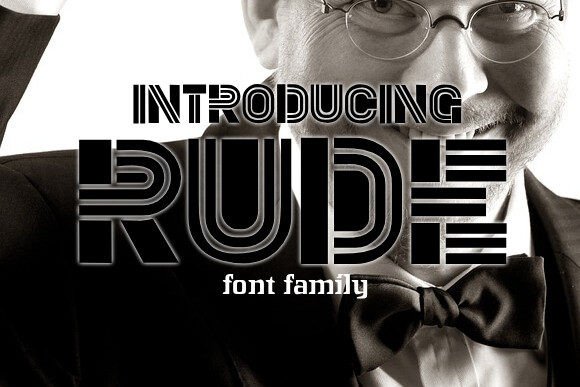
The Rude font family belongs to the category of heavy-weight, condensed sans-serif display fonts. Its primary distinction lies in its aggressive geometry and high contrast in stroke weight. Unlike traditional serif fonts that rely on historical elegance or standard sans-serifs that prioritize neutrality, Rude embraces a raw, industrial aesthetic. The letterforms are constructed with sharp angles and thick strokes, creating a visual impact that is immediately recognizable even at small sizes, though it truly excels when scaled up.
What makes Rude distinct is its versatility within a single family. While the core style is undeniably bold, the family often includes variations in weight and width, allowing for subtle adjustments without losing the signature "rude" personality. This consistency ensures that headlines and subheadings can work together harmoniously while maintaining a cohesive brand voice. The font's structure is optimized for legibility in short bursts of text, making it ideal for titles and slogans rather than long-form reading material.
Visual Impact and Structural Integrity
When evaluating a display font, structural integrity is paramount. Rude maintains its shape well under various transformations, such as stretching or condensing, which is a common requirement in poster design. The thick stems prevent the letters from breaking apart when used with texture overlays or distressed effects, a popular trend in streetwear and event marketing. However, this heaviness comes with a tradeoff: the font requires generous leading (line spacing) and kerning to avoid looking cluttered. If the negative space between characters is too tight, the aggressive nature of the typeface can become difficult to read.
Comparing Rude to Alternative Display Styles
To make an informed decision, it is helpful to compare Rude against other common typographic categories used for similar purposes. When choosing a font for a high-impact design, designers often oscillate between gothic blackletter styles, geometric sans-serifs, and hand-drawn scripts. Each offers a different emotional resonance.
- Gothic and Blackletter Fonts: These styles offer a historical, sometimes intimidating authority. While they share the "bold" characteristic with Rude, they often lack the modern clarity required for digital screens or quick glances. Rude provides a contemporary alternative that feels edgy without appearing dated or overly ornate.
- Geometric Sans-Serifs: Fonts like Futura or Helvetica Neue are clean and professional but can feel sterile for projects requiring a rebellious or energetic tone. Rude injects personality where geometric fonts might feel too corporate. If your goal is neutrality, Rude is likely the wrong choice; if the goal is disruption, it is superior.
- Hand-Drawn Scripts: Script fonts convey approachability and creativity but often struggle with legibility at large scales or on textured surfaces like fabric. Rude offers the strength needed for t-shirt prints where durability and readability are key, whereas scripts may lose definition after washing or printing.
The Tradeoff Between Aggression and Legibility
A critical factor in comparing Rude to other options is the balance between aggression and legibility. Some ultra-bold fonts sacrifice character distinction for sheer mass, making it hard to distinguish an 'I' from an 'l' or an 'O' from a '0'. Rude generally avoids this pitfall by maintaining clear counter shapes and distinct terminals. However, it is still a display font. Using it for body text in a flyer or a paragraph on a website will result in a poor user experience. In this regard, it shares limitations with most heavy display families: it is a specialist tool, not a general-purpose solution.
Best-Fit Situations for Rude
Understanding when to deploy Rude is just as important as understanding what it is. The font thrives in environments where brevity and impact are the primary goals. Its design language aligns perfectly with industries and events that value energy, youth culture, and direct communication.
Posters and Event Flyers
For concert posters, festival flyers, and promotional events, Rude is an excellent candidate. The condensed nature of the font allows for large headlines to fit within vertical layouts without wasting horizontal space. Imagine a music festival flyer where the band name needs to dominate the visual hierarchy; Rude delivers that dominance effectively. The thick strokes also hold up well against complex background images, ensuring the text remains readable even when placed over busy photography or abstract art.
T-Shirt and Merchandise Design
Apparel design presents unique challenges regarding print techniques and fabric interaction. Screen printing, in particular, benefits from fonts with solid, unbroken forms. Rude's robust structure minimizes the risk of ink bleeding or gaps appearing in thin lines during the printing process. On a t-shirt, the font creates a strong silhouette that reads clearly from a distance. Whether the design is a simple chest logo or a large back graphic, Rude provides the necessary visual weight to stand out in a crowd. It pairs particularly well with minimalist color palettes, allowing the typography itself to serve as the main graphic element.
Digital Headers and Social Media Graphics
In the digital realm, attention spans are measured in milliseconds. Social media graphics need to communicate a message instantly. Rude's boldness cuts through the noise of a scrolling feed. It is effective for Instagram stories, YouTube thumbnails, and banner ads where the headline must be understood before the user decides to click. However, designers must ensure the file size remains optimized, as heavy fonts can sometimes increase load times if not properly converted to outlines or web formats.
Limitations and Decision Factors
While Rude is powerful, it is not a universal solution. There are scenarios where its use would be detrimental to the overall design and brand perception. Understanding these limitations is crucial for professional application.
- Long-Form Content: As mentioned, Rude should never be used for paragraphs of text. The high x-height and heavy weight cause eye fatigue quickly. If your project involves significant amounts of copy, pair Rude with a highly legible, lighter sans-serif or serif font for the body text.
- Formal Contexts: The inherent "attitude" of the font makes it unsuitable for formal invitations, legal documents, or conservative corporate communications. Using Rude in these contexts can appear unprofessional or dismissive.
- Small Print Sizes: While the font is readable at medium sizes, shrinking it down to 6pt or smaller can cause the details to blur, especially in low-resolution prints. It is best reserved for headlines larger than 24pt.
Evaluating Brand Alignment
Before committing to Rude, consider the brand identity you are trying to establish. Does the brand voice align with the font's personality? If the brand is about luxury, tranquility, or tradition, Rude may clash with those values. Conversely, if the brand represents innovation, street culture, or disruptive technology, the font reinforces the message. The decision should always be driven by the emotional response you want to evoke in the audience.
Practical Implementation Strategies
To get the most out of the Rude font family, designers should employ specific strategies that enhance its strengths while mitigating its weaknesses. One effective technique is pairing. Combining Rude with a neutral, thin sans-serif creates a dynamic contrast that guides the reader's eye. The bold headline grabs attention, while the delicate body text invites the reader to learn more.
Another strategy involves manipulating the tracking (letter-spacing). Because Rude is naturally dense, increasing the tracking slightly can add a sense of airiness and sophistication, preventing the text from feeling too cramped. Conversely, tightening the tracking can create a block-like effect suitable for brutalist design trends. Experimentation with color gradients or texture fills within the letters can also leverage the font's solid shapes, turning the text into a graphical object in its own right.
Conclusion on Selection Criteria
The Rude font family is a potent tool for designers who need to make a loud, clear statement. Its suitability for posters, flyers, and t-shirts is backed by its structural robustness and high visual impact. However, its effectiveness is contingent on appropriate usage. It shines in headlines and short phrases but falters in long-form content or formal settings. By weighing its aggressive style against the specific requirements of your project and comparing it to alternative typographic approaches, you can determine whether Rude is the right fit. Ultimately, the best font is the one that serves the message, and for designs requiring confidence and edge, Rude offers a compelling, stylish solution.