Evaluating Mojito Youth: A Practical Guide to Its Design and Application
In the crowded landscape of display typography, finding a font that successfully bridges the gap between nostalgic warmth and modern utility is a rare achievement. Mojito Youth emerges as a compelling candidate for designers seeking this specific aesthetic balance. It is not merely a decorative script; it is a carefully constructed typeface designed to evoke the tactile feel of handmade writing while maintaining the legibility required for contemporary branding. For professionals ranging from package designers to digital marketers, understanding the nuances of Mojito Youth is essential for determining whether it fits into a specific project workflow.
The Intersection of Vintage Charm and Modern Utility
The primary appeal of Mojito Youth lies in its ability to capture a retro spirit without feeling dated. Many vintage-style fonts suffer from being overly ornate or difficult to read at smaller sizes, limiting their use to large headlines only. In contrast, this typeface was crafted with a dual purpose: to trigger a sense of nostalgia while exuding a vibrant, youthful energy. This combination makes it particularly effective for brands that want to signal authenticity and heritage but need to remain relevant to a younger demographic.
The design philosophy behind Mojito Youth reflects a deliberate move away from the sterile perfection of standard geometric sans-serifs. Instead, it embraces the irregularities inherent in human handwriting. These imperfections are not errors; they are intentional design choices that contribute to the font's authentic vintage appeal. When evaluating a typeface for long-term value, consistency is key, yet Mojito Youth manages to maintain character consistency across its glyph set while allowing enough variation to prevent visual monotony. This balance ensures that the font feels organic rather than mechanical.
Key Characteristics and Design Analysis
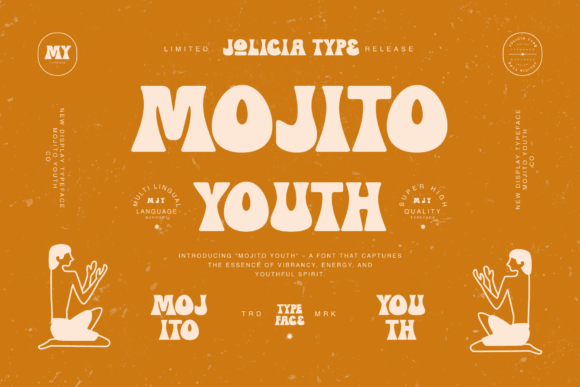
To understand the practical value of Mojito Youth, one must examine its structural components. The font features rounded terminals and varying stroke widths that mimic the pressure of a brush or a felt-tip pen. This "handmade" quality is what gives the typeface its cheerful and youthful elegance. Unlike rigid scripts that can appear stiff, the curves in Mojito Youth flow naturally, suggesting movement and spontaneity.
- Irregular Baselines: Slight variations in letter height add to the hand-drawn aesthetic, making text blocks feel more dynamic.
- Stroke Variation: The contrast between thick and thin lines is pronounced but controlled, ensuring readability even at moderate sizes.
- Modern Touches: While rooted in retro aesthetics, the kerning and spacing have been optimized for screen display, addressing a common weakness in older display fonts.
From a technical standpoint, the reliability of Mojito Youth is evident in how it handles different weights and styles. The font does not rely on excessive embellishments that might clutter a layout. Instead, it uses negative space effectively, allowing the letters to breathe. This restraint is crucial for professional applications where clarity cannot be compromised for the sake of style. The font strikes a balance between past and present, making it versatile for a variety of applications, from bold logos to subtle packaging details.
Real-World Performance and Usability
When moving from concept to execution, the usability of a font becomes the deciding factor. Mojito Youth performs well in scenarios requiring high visual impact. For instance, in product packaging, the font's organic nature aligns perfectly with industries such as craft beverages, artisanal foods, and boutique fashion. The "Mojito" in the name suggests a connection to refreshment and leisure, which translates visually into a light, airy presentation that appeals to consumers looking for genuine experiences.
However, like any display font, there are limitations to consider. Mojito Youth is best suited for headlines, short phrases, and logo lockups. It is not designed for extended body copy. Attempting to use it for paragraphs of text would likely result in poor readability due to the intricate details and irregular shapes. Professionals should treat it as an accent element rather than a workhorse for content-heavy layouts. In digital environments, the font renders cleanly on high-resolution screens, but designers should test it on mobile devices to ensure the finer strokes do not disappear at very small sizes.
Flexibility Across Media
The versatility of Mojito Youth extends beyond print. In web design, it serves as an excellent choice for hero sections, call-to-action buttons, and section headers. Its distinct personality helps break up the uniformity of standard UI elements, guiding the user's eye to important information. For social media graphics, the font's playful nature resonates well with audiences scrolling through feeds, offering a moment of visual delight that encourages engagement.
Furthermore, the font's adaptability allows it to pair effectively with more neutral typefaces. A common strategy is to combine Mojito Youth with a clean, geometric sans-serif or a traditional serif for body text. This pairing creates a hierarchy that leverages the charm of the display font while maintaining the professionalism needed for informational content. The modern touch embedded in the design ensures that these combinations do not feel disjointed but rather cohesive and intentional.
Ideal Use Cases and Target Audience
Who benefits most from integrating Mojito Youth into their toolkit? The answer lies in the sectors that prioritize storytelling and emotional connection. Entrepreneurs launching lifestyle brands, freelancers designing wedding invitations, and marketers creating campaigns for summer products will find this font particularly useful. It speaks directly to adults aged 20–50 who appreciate craftsmanship and authenticity.
For small business owners, Mojito Youth offers a cost-effective way to elevate brand identity. A logo utilizing this font can instantly communicate a sense of care and attention to detail, distinguishing the business from competitors using generic, mass-market typefaces. Educators and publishers might also find value in its application for book covers, educational materials, or event posters where a friendly, approachable tone is desired.
However, the font may not be suitable for all contexts. Industries requiring strict formality, such as legal services, healthcare administration, or corporate finance, should exercise caution. The playful and irregular nature of Mojito Youth could undermine the seriousness required in these fields. It is essential to match the font's personality with the brand's voice and the audience's expectations.
Professional Observations and Recommendations
After evaluating the strengths and weaknesses of Mojito Youth, several practical recommendations emerge for potential users. First, always test the font in the context of your final medium. What looks charming on a monitor might behave differently when printed on textured paper or viewed on a low-resolution device. Second, pay close attention to leading and tracking. Because of the font's organic shape, default spacing settings might not always provide the optimal visual rhythm. Adjusting these parameters can significantly enhance the overall presentation.
Additionally, consider the longevity of the trend. While retro aesthetics have remained popular for years, the specific interpretation of "youthful vintage" evolves. Mojito Youth appears positioned to withstand these shifts due to its focus on fundamental handwriting qualities rather than fleeting stylistic gimmicks. This suggests a good long-term value for designers looking to build a sustainable asset library.
Finally, let your creativity flow with the perfect blend of vintage charm and contemporary style, but do so with intention. Mojito Youth is a tool, not a solution in itself. Its effectiveness depends entirely on how well it is integrated into a broader design system. By understanding its unique characteristics and respecting its limitations, designers can leverage its full potential to create work that is both visually striking and functionally sound.