Funny Spring: A Playful Display Font That Demands Careful Use
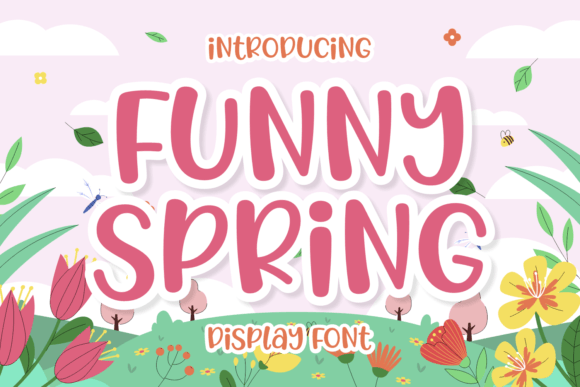
If you are looking to inject a sense of whimsy and approachability into your visual projects, Funny Spring is a compelling choice. This cute display font carries a friendly touch that instantly softens the tone of any message. Unlike standard text fonts designed for dense paragraphs, Funny Spring is engineered to make a bold visual statement. It grabs attention immediately, making it perfect for headlines, titles, logos, posters, and signage where impact matters more than reading speed.
However, selecting a font with such a distinct personality requires more than just liking how it looks in a preview window. Many designers, marketers, and small business owners rush to download or purchase playful typefaces without considering the functional limitations they bring. When used incorrectly, even the most charming font can undermine your brand's credibility or confuse your audience. Understanding exactly what Funny Spring is and where it fits within your design ecosystem is crucial for achieving professional results.
Understanding the Purpose of Display Fonts
The first step in using Funny Spring effectively is recognizing its classification as a display font. This distinction is often overlooked by beginners who assume all fonts are interchangeable. Text fonts, like Arial or Georgia, are optimized for readability in long-form content. They have open counters, consistent x-heights, and neutral shapes that allow the eye to glide across lines of text without fatigue.
In contrast, display fonts like Funny Spring are intended for larger sizes and shorter bursts of text. Their unique character shapes, decorative elements, and varying stroke widths are meant to be seen from a distance or scanned quickly. If you attempt to use Funny Spring for body copy in an article, blog post, or product description, you will likely create a frustrating reading experience. The intricate details that make the font "cute" become obstacles when scaled down, causing the text to blur or look messy on screens and print materials alike.
Common Mistakes When Applying Funny Spring
One of the most frequent errors I see is the overuse of decorative typefaces in critical communication areas. Designers often fall in love with the aesthetic of a font and apply it everywhere, ignoring hierarchy. For instance, using Funny Spring for both the main headline and the subheadings can flatten the visual structure of a poster or webpage. Without a clear contrast between headings and body text, the viewer struggles to prioritize information.
Another common pitfall is neglecting legibility in digital environments. While Funny Spring might look crisp on a high-resolution monitor, it can struggle on mobile devices or low-quality web displays if not sized correctly. The "friendly touch" of the font relies on specific spacing and weight. If you shrink the font too much to fit a social media caption or a footer, those charming curves may lose their definition, turning your message into an illegible blob.
Furthermore, there is a misunderstanding regarding brand consistency. Some entrepreneurs choose a playful font like Funny Spring because it feels fun, only to realize later that it clashes with the serious nature of their industry. A financial advisor or a legal firm using this font for their logo might unintentionally signal a lack of professionalism. The font itself isn't "bad," but its application must align with the trust and authority required by the sector.
Strategic Applications for Branding and Advertising
When used correctly, Funny Spring becomes a powerful tool for branding, editorial design, packaging, advertising, and digital media. Its strength lies in creating an immediate emotional connection. Imagine a children's book cover, a spring sale flyer, or a bakery logo. In these contexts, the font's personality enhances the message rather than distracting from it.
To avoid the mistakes mentioned above, consider pairing Funny Spring with a clean, neutral sans-serif or serif font for your body text. This combination creates a balanced hierarchy where the display font draws the eye to the title, while the supporting text ensures the details are easily consumed. For example, a poster for a community festival could feature "Spring Festival 2024" in large, bold Funny Spring lettering, while the event schedule and location details remain in a simple, readable font below.
When designing packaging, remember that space is limited. Using Funny Spring for the product name is excellent, but ensure the ingredient list and nutritional information adhere to regulatory standards for legibility. Do not try to force the decorative font into mandatory small-print sections. This not only risks non-compliance but also frustrates consumers trying to find essential information.
Evaluating Your Decision Before Downloading or Buying
Before you commit to downloading or purchasing Funny Spring, take a moment to evaluate your specific project needs. Ask yourself if the tone of the font matches the intent of the message. Is your goal to entertain, inform, or persuade? If the primary goal is rapid information transfer, a display font might not be the best lead. However, if you need to stop a scrolling user in their tracks, Funny Spring is an ideal candidate.
Also, check the licensing terms carefully. Many free fonts come with restrictions on commercial use, while premium versions offer broader permissions for branding and merchandise. Ensure that the license covers your intended applications, whether that is a logo for a startup or graphics for a marketing campaign. Ignoring these details can lead to costly legal issues down the road.
Finally, test the font in real-world scenarios. Don't just rely on the specimen sheet provided by the foundry. Create a mockup of your actual project—a website header, a business card, or a social media graphic—and view it at different sizes and on different devices. Does the friendly touch still read clearly? Does it stand out against your background colors? These practical tests will reveal potential usability issues before you invest time and money into a full design rollout.
By respecting the boundaries of display typography and applying Funny Spring with intention, you can harness its charm to elevate your designs. Avoid the trap of treating every font as a universal solution. Instead, let the unique characteristics of Funny Spring guide your creative decisions, ensuring that your final output is not only visually striking but also functionally sound and effective for your audience.