Marco: The Geometrical Typeface That Brings Whimsy to Modern Design
In the vast landscape of digital typography, where sans-serif fonts often dominate with their clean lines and utilitarian efficiency, there exists a distinct category of typefaces that refuse to be merely functional. These are the fonts that inject personality, narrative, and emotion into static text. Marco stands as a prime example of this movement. As a quirky geometrical font, Marco bridges the gap between structured mathematical precision and playful, human-centric expression. It is not just a tool for setting type; it is a design element in its own right, capable of transforming a standard layout into an engaging visual experience.
The appeal of Marco lies in its ability to balance two seemingly contradictory forces: geometry and whimsy. While traditional geometric sans-serifs like Futura or Avant Garde rely on strict circles and triangles to convey modernity and stability, Marco takes these foundational shapes and introduces subtle irregularities. This approach allows designers to maintain the readability and structure associated with geometric forms while simultaneously adding a layer of charm that resonates with audiences seeking authenticity and creativity.
The Anatomy of a Quirky Geometrical Font
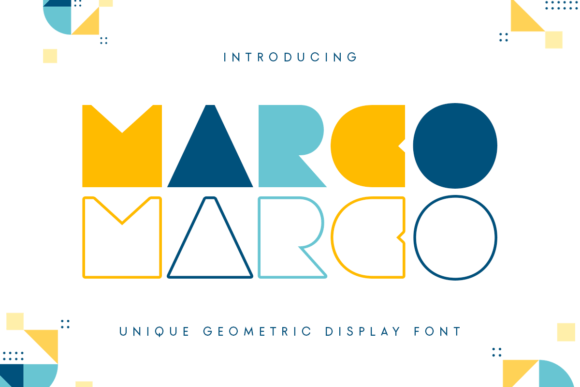
To truly appreciate how Marco functions within a design system, one must first understand its construction. At its core, Marco is built upon the principles of geometric typography. The letterforms are derived from basic shapes—circles, squares, and lines—which provide a sense of order and rhythm. However, the "quirky" designation comes from the intentional deviations from perfect symmetry.
Consider the letter 'O'. In a standard geometric font, this character is a perfect circle. In Marco, the circle might be slightly flattened at the top or bottom, or perhaps the stroke weight varies subtly across the curve. Similarly, the counter spaces—the enclosed areas within letters like 'a', 'e', and 'o'—might be shaped in ways that feel organic rather than manufactured. These small adjustments prevent the text from feeling cold or robotic.
This structural nuance is what makes Marco so versatile. It retains the legibility required for body copy in many contexts but offers enough character to stand out in headlines. The font's architecture supports a wide range of weights, allowing it to scale effectively from large display sizes down to smaller interface elements without losing its distinctive personality. When you add Marco confidently to your projects, you are leveraging a typeface that has been engineered to hold attention without sacrificing clarity.
Visual Characteristics That Define the Style
The visual language of Marco is defined by several key characteristics that set it apart from other display fonts. First is the modulation of stroke weight. Unlike monolinear geometric fonts, Marco often employs variable thicknesses that mimic the natural flow of handwriting or brush strokes, yet remain grounded in geometric logic. This creates a dynamic texture when viewed at a distance.
Secondly, the terminals—the ends of the strokes—are rarely cut straight across. They may be rounded, flared, or tapered in unique ways that contribute to the overall whimsical feel. These details are crucial because they guide the eye through the text in a fluid motion, making reading a more pleasant experience. Finally, the x-height of Marco is typically generous, which enhances readability and gives the font an open, friendly appearance. These features combine to create a typeface that feels both contemporary and timeless.
Strategic Applications in Professional Design
While the playful nature of Marco might suggest it is limited to children's books or party invitations, its utility extends far beyond casual applications. Professionals across various industries have discovered that incorporating a quirky geometrical font can significantly enhance brand perception and user engagement. The key lies in understanding where and how to deploy the font to maximize its impact.
In the realm of branding, Marco serves as an excellent choice for companies that want to project innovation and approachability. Tech startups, creative agencies, and lifestyle brands often use such typefaces to differentiate themselves from competitors who rely on safe, corporate-standard fonts. By using Marco for logos or primary headlines, these businesses signal to their audience that they value creativity and are not afraid to break the mold. The font's geometric roots ensure it still looks professional, while its quirks add a touch of humanity.
Educators and content creators also find immense value in Marco. In e-learning modules, educational posters, and interactive presentations, maintaining student engagement is paramount. A monotone, strictly formal typeface can sometimes lead to cognitive fatigue. Introducing Marco into headers and call-out boxes breaks up the visual monotony, signaling to the learner that the information is important yet accessible. The whimsical nature of the font can make complex topics feel less intimidating and more inviting.
Use Cases in Digital Interfaces and Marketing
Digital environments present unique challenges for typography, requiring fonts to render clearly across various screen resolutions and devices. Marco performs admirably in these settings, particularly in web design and mobile applications. Its clear letterforms ensure that users can read content quickly on small screens, while its personality helps establish a strong emotional connection with the user interface.
For marketing campaigns, Marco is a powerful asset in social media graphics and email newsletters. In a feed saturated with generic templates, a post featuring Marco immediately catches the eye. The font's ability to brighten up designs makes it ideal for promotional materials that need to convey excitement or joy. Whether it is announcing a new product launch or highlighting a special offer, Marco adds a layer of enthusiasm that plain text cannot achieve. Furthermore, its versatility allows it to pair well with both serif and sans-serif companion fonts, giving designers flexibility in creating cohesive layouts.
Navigating the Balance Between Playfulness and Legibility
Despite its many advantages, integrating a quirky font like Marco requires careful consideration. The line between "whimsical" and "distracting" is thin, and crossing it can undermine the effectiveness of a design. One of the primary considerations for any designer using Marco is context. While the font excels in headlines and short bursts of text, it may not be suitable for long-form body copy in all scenarios.
Readability is the cornerstone of effective communication. If a font is too stylized, the reader's brain must work harder to decode the characters, leading to frustration and disengagement. Therefore, when using Marco, it is essential to test it at various sizes and against different backgrounds. High contrast and adequate spacing are critical factors that influence how well the font performs. Designers should avoid overusing decorative styles or overly condensed versions of the font, as these can compromise legibility.
Another consideration is the pairing strategy. Because Marco is so distinct, it often works best when paired with a neutral, understated typeface for body text. This combination allows Marco to shine in headlines and accents without overwhelming the reader. For instance, pairing Marco with a clean, minimalist sans-serif creates a balanced hierarchy where the quirky font draws attention to key messages, while the supporting font ensures the rest of the content remains easy to digest.
Ensuring Accessibility and Inclusivity
In today's digital landscape, accessibility is not optional; it is a fundamental requirement. When selecting a font like Marco, designers must ensure that it meets accessibility standards for users with visual impairments or dyslexia. The open counters and clear distinction between similar characters (such as 'I', 'l', and '1') are positive attributes of Marco that aid in readability. However, designers should still verify that the chosen weight and size meet minimum contrast ratios and do not introduce unnecessary visual noise.
Furthermore, cultural context plays a role in how a font is perceived. What appears whimsical in one culture might be interpreted differently in another. Understanding the target audience and their expectations regarding typography is crucial for successful implementation. By testing designs with real users and gathering feedback, designers can refine their use of Marco to ensure it communicates the intended message effectively across diverse demographics.
The Future of Expressive Typography
The rise of fonts like Marco reflects a broader shift in design trends toward authenticity and emotional resonance. As consumers become increasingly adept at spotting generic, mass-produced content, they crave experiences that feel personal and crafted. Typography is no longer just about conveying information; it is about evoking feelings and building relationships. In this evolving landscape, the demand for expressive, character-driven typefaces will only continue to grow.
We are moving away from the era of rigid minimalism toward a future where geometry and playfulness coexist harmoniously. Fonts that can adapt to different moods and contexts, like Marco, will become essential tools for designers aiming to create memorable and impactful work. The ability to brighten up each of your designs with a single typographic choice represents a significant advantage in a crowded marketplace.
As technology advances, we may see even more sophisticated variations of geometric fonts that incorporate dynamic elements, such as variable axes that allow users to adjust the level of whimsy in real-time. However, the core principle remains the same: great typography connects with people on a human level. Marco exemplifies this connection, proving that a font can be both structurally sound and delightfully unpredictable.
Embracing Confidence in Creative Choices
Ultimately, the decision to use a font like Marco is a statement of confidence. It signals a willingness to take risks and explore new aesthetic territories. For professionals, hobbyists, and business owners alike, embracing such a typeface can lead to unexpected breakthroughs in design and communication. When you love the results, it is often because you have chosen a tool that aligns with your vision and values.
Whether you are designing a logo for a startup, creating educational materials for a classroom, or crafting a marketing campaign for a global brand, Marco offers a unique opportunity to stand out. Its blend of geometric precision and whimsical flair makes it a versatile asset that can adapt to a wide range of needs. By understanding its characteristics and applying it thoughtfully, you can elevate your projects and create designs that resonate deeply with your audience.
The journey of exploring typefaces like Marco is ongoing, offering endless possibilities for creativity and expression. As you continue to experiment and refine your skills, remember that the right font can transform the way your message is received. With Marco, you have a partner in design that is ready to bring color, character, and clarity to every project you undertake.